Geomorphology and Stream Ecology
Fluvial processes govern how water and sediment move through river networks, shaped by geology, topography, land cover, and climate. Although rivers have long fascinated geomorphologists, many questions remain about how they convey water and sediment while maintaining stable forms. Understanding these processes helps us predict sediment production and transport, assess how often transport events occur, and evaluate how changes in land cover or climate can alter river behavior. Sediment transport is also critical for river ecology because it reshapes the channel bed and influences habitat for benthic organisms at the base of aquatic food webs.
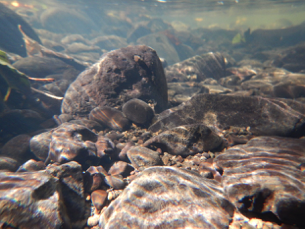
Bed load transport modeling. New equation using 2D shear stress distributions Bed‑load transport in gravel‑bed rivers is often estimated using reach‑averaged shear stress, but this oversimplifies the wide range of stresses created by complex flow fields. We developed a modified, subsurface‑based transport equation that incorporates the full shear‑stress distribution for a given flow and calibrated it using bed‑load measurements from Oak Creek, OR. This approach improves the accuracy of sediment‑transport estimates compared with traditional methods. NSF Award #1619700. See here.
Relationship between stream sediment transport and primary production Primary production provides the fundamental source of energy for most life on earth, and therefore understanding what controls primary production is key to understanding ecosystems. In streams, relevant research has focused on the influence of light and nutrients, but the role of underlying geology and sediment transport has not been well explored. The algae that dominate primary producers in headwater streams live on rock substrates. Flow events that mobilize those rocks can scrape algae away and reset the system to low production levels. Understanding controls on frequency of substrate scour and transport in a steam is therefore fundamental to understanding the temporal and spatial dynamics of primary production. NSF Award #1619700. See here.
Lithology, channel geometry, and bed sediment organization hillslope-coupled streams: In steep settings, hillslope and in-stream processes are often closely connected. Coarse sediment and large wood can enter streams directly, affecting channel geometry and sediment transport downstream. Predicting these factors at the landscape scale requires better understanding of hillslope–channel interactions. Therefore, we study the longitudinal patterns of channel geometry in two neighboring watersheds in the Oregon Coast Range, with differing lithology (volcanic and sedimentary) that may influence their hillslope and in-channel processes differently. NSF Award #1619700 See here