Effects of fire on hydrologic function
Fire-water: In collaboration with Julian Klaus (University of Bonn), we aim to provide a unique pre- and post-fire dataset on streamflow, hydrological tracers, and water quality. We will quantify changes in hydrological processes—specifically stream water sources and transit times—for six watersheds using stable water isotopes. See here.
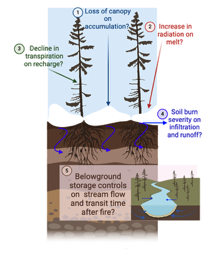
Fire-Snow-Runof: In collaboration with Pamela Sullivan and Mark Raleigh, our aim is to disentangle the impacts of soil burn severity (SBS) and tree mortality on snow dynamics, infiltration, and runoff generation across watersheds with contrasting storage capacities. NSF Project (#2424997).
Low flows
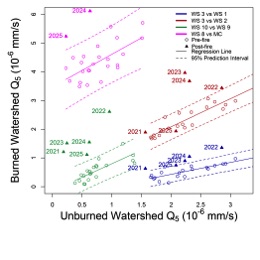
After wildfire, evapotranspiration is reduced, impacting the water budget of impacted watersheds. In the HJA, this resulted in more of the water received during the wet months to be available for sustaining flows throughout the dry summer months, ultimately yielding higher low flows (Q5). Using a before-after-control-impact (BACI) analysis, low flows in burned watersheds were higher post-fire than would be predicted given the low flows occurring in nearby unburned paired watersheds.